Industrial Automation for SMEs: How to Improve Production Line Efficiency with Conveyor Belt Systems
Blog post descrAs Southeast Asia’s manufacturing sector expands, SMEs are investing in conveyor belt systems to improve production efficiency and reduce factory downtime. iption.
Introduction: The Hidden Bottleneck in Growing Factories
Across Southeast Asia, entrepreneurs are scaling food production, packaging operations, and light manufacturing businesses at unprecedented speed. Demand is rising. Competition is intensifying. Margins are tightening.
Yet many factories still rely on semi-manual material handling workers carrying products between stations, inconsistent flow between processing stages, and production lines that stop whenever one station slows down.
The result? Delays, labor inefficiencies, product damage, and unnecessary factory downtime.
For SME factory owners asking, “how to improve production line efficiency” or “how entrepreneurs can scale manufacturing businesses without increasing labor costs?” the answer often begins with one foundational system: a properly engineered conveyor belt system for production line operations.
Why Conveyor Belt Systems Matter in Southeast Asia’s Manufacturing Growth
Southeast Asia has become a critical hub for food processing, packaging, and light industrial manufacturing. Countries like Malaysia, Thailand, Vietnam, and Indonesia are seeing steady expansion in domestic brands and export-oriented SMEs.
However, industrial automation Southeast Asia trends show a clear divide:
Larger corporations invest early in automation.
Smaller factories delay upgrades due to budget concerns.
Many SMEs underestimate how much manual material handling costs them over time.
As wages rise and quality standards increase, SME factory automation is no longer optional. It is a competitive requirement.
One of the most accessible and scalable automation investments is a conveyor belt system designed specifically for the production line.
What Is a Conveyor Belt System for Production Line Operations?
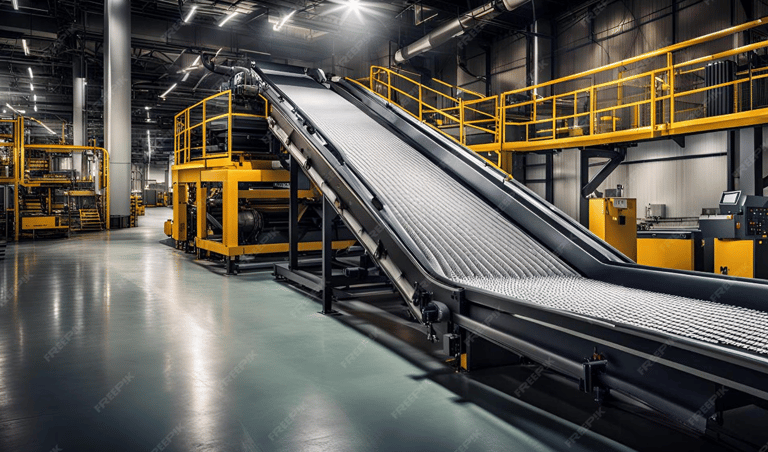
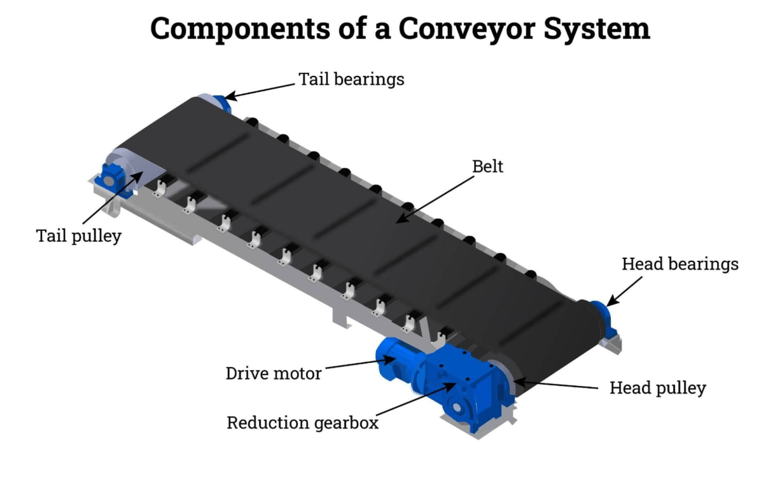
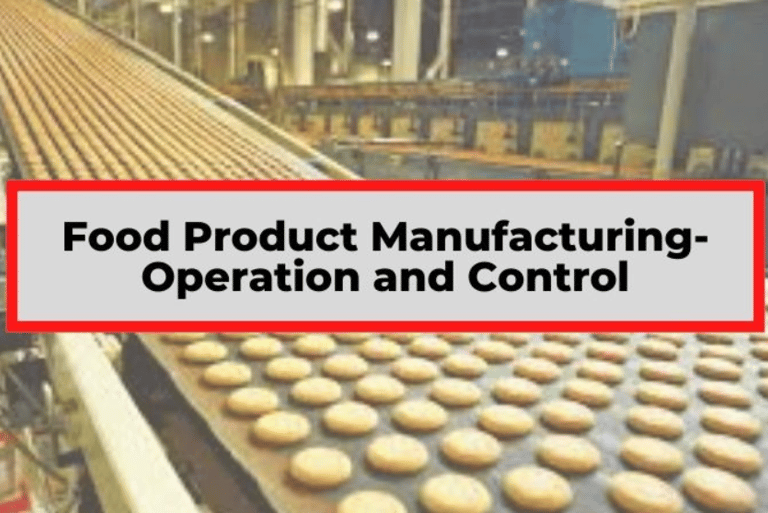
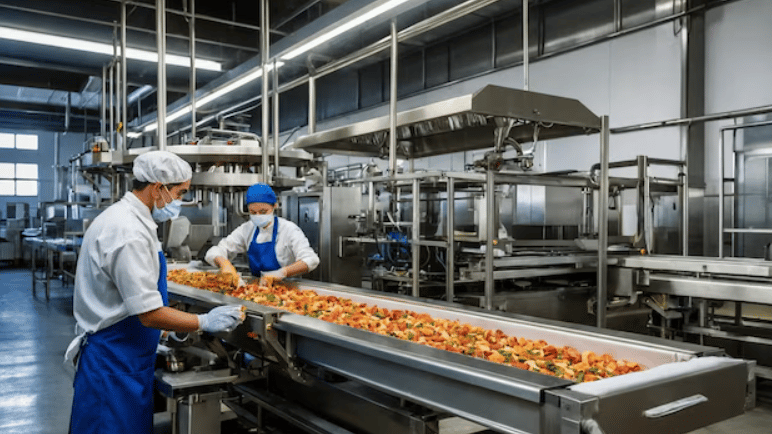
A conveyor belt system is a mechanical handling system that transports raw materials, semi-finished goods, or finished products between different production stages automatically.
Instead of workers manually transferring items, the system:
Moves products at controlled speeds
Synchronizes production stages
Reduces human handling errors
Creates consistent production flow
In food manufacturing, conveyors can be integrated with:
Sorting stations
Spray control systems
Inspection units
Packaging machines
Unlike highly complex robotics, conveyors are modular and scalable production systems. They can be installed gradually as a business grows.
For entrepreneurs searching for the “best automation solutions for small factories”, conveyors often provide the highest operational impact per dollar invested.
How Conveyor Systems Improve Food Manufacturing Efficiency
1. Production Flow Optimization
Manual transfer between stations creates micro-delays that compound across shifts. A conveyor belt system standardizes flow speed and eliminates unpredictable stoppages between processes.
This directly supports manufacturing productivity improvement.
2. Labor Cost Optimization
Workers can focus on quality control, monitoring, and value-added tasks rather than repetitive transport activities. This improves output per employee without necessarily increasing headcount.
3. Reduced Product Damage and Waste
In food manufacturing, mishandling leads to contamination, spills, and breakage. A stable transport system protects product integrity and enhances food manufacturing efficiency.
4. Integration with Other Automation Systems
Conveyor systems can integrate with:
Automated spray control system units
Solenoid valve nozzle applications
Weighing and inspection stations
This creates a synchronized, scalable production line.
Business Impact: ROI Beyond Machinery
When evaluating automation, entrepreneurs often focus only on upfront cost. The real question should be:
How does this investment reduce operational risk and increase scalability?
Factory Downtime Reduction
Manual systems are prone to bottlenecks. When one worker slows down or is absent, the entire line suffers. Automated material handling creates predictable movement, directly contributing to factory downtime reduction.
For business owners researching “how to reduce factory downtime”, conveyor integration is one of the most immediate structural solutions.
Scalability Without Facility Expansion
A well-designed conveyor layout allows production capacity to increase without expanding physical space. Flow optimization improves throughput using the same footprint.
Competitive Advantage
In modern supply chains, buyers prioritize:
Consistent output
Shorter lead times
Predictable production schedules
Automation signals operational maturity.
Common Mistakes SME Factories Make
Even forward-thinking entrepreneurs sometimes misstep when investing in automation.
1. Buying Generic Conveyor Systems
Not all conveyor systems are suitable for food production or specialized manufacturing. Material type, hygiene requirements, and load specifications must be considered.
2. Ignoring Workflow Design
Installing a conveyor without rethinking layout leads to inefficient flow. Automation should follow process optimization — not the other way around.
3. Underestimating Maintenance Planning
Even simple systems require preventive maintenance. Ignoring maintenance increases long-term factory repair services costs.
4. Over-Automating Too Quickly
Full-scale automation is not always necessary. Start with modular systems that can scale gradually.
5. Choosing Price Over Engineering Expertise
Working with an experienced industrial machinery supplier Southeast Asia ensures long-term reliability and integration capability.
Frequently Asked Questions (FAQ)
What is a conveyor belt system in manufacturing?
A conveyor belt system is a mechanical transport solution that moves products between production stages automatically, improving workflow consistency and reducing manual handling.
How does a conveyor system improve manufacturing efficiency?
It standardizes material flow, reduces labor dependency, minimizes product damage, and supports continuous production — leading to improved output and reduced downtime.
Is it suitable for small factories?
Yes. Conveyor systems are scalable production systems that can be customized for SME factory automation needs and expanded as the business grows.
How does it help reduce factory downtime?
By eliminating manual bottlenecks and creating predictable movement between stations, conveyors reduce process interruptions and improve overall operational stability.
What GMT Machinery Offers
As an industrial automation supplier Southeast Asia businesses trust, GMT Machinery supports entrepreneurs and factory owners in building scalable, efficient production systems.
Our solutions include:
Conveyor belt systems for production line integration
Automated spray control systems (including solenoid valve nozzle and CYVO type systems)
Drone spray control systems
Comprehensive factory machinery repair services
We focus on practical, engineering-driven solutions that help businesses:
Achieve factory downtime reduction
Improve production efficiency
Build scalable production systems
Strengthen long-term competitiveness
Modern manufacturing is not about replacing people. It is about designing smarter systems that allow people and processes to operate at higher levels of productivity.
Entrepreneurs who invest strategically in automation today position their businesses for stability, growth, and operational resilience tomorrow.
In Southeast Asia’s rapidly evolving manufacturing landscape, efficiency is no longer a luxury. It is the foundation of sustainable success.